
Dissipation-Based Quantum Algorithms
Dissipative dynamics offers a promising route for preparing thermal and ground states of quantum many-body systems, and has seen rapid development in recent years. Our goal is to develop more practical implementations of dissipative quantum algorithms and to identify near-term applications where they can provide useful physical insight.
Dissipative cooling in a realistic setting
- [1] Dissipative phase decision without ground-state preparation
HE Li*, Y. Yang*, L. Lin, arXiv:2606.28750 [quant-ph]
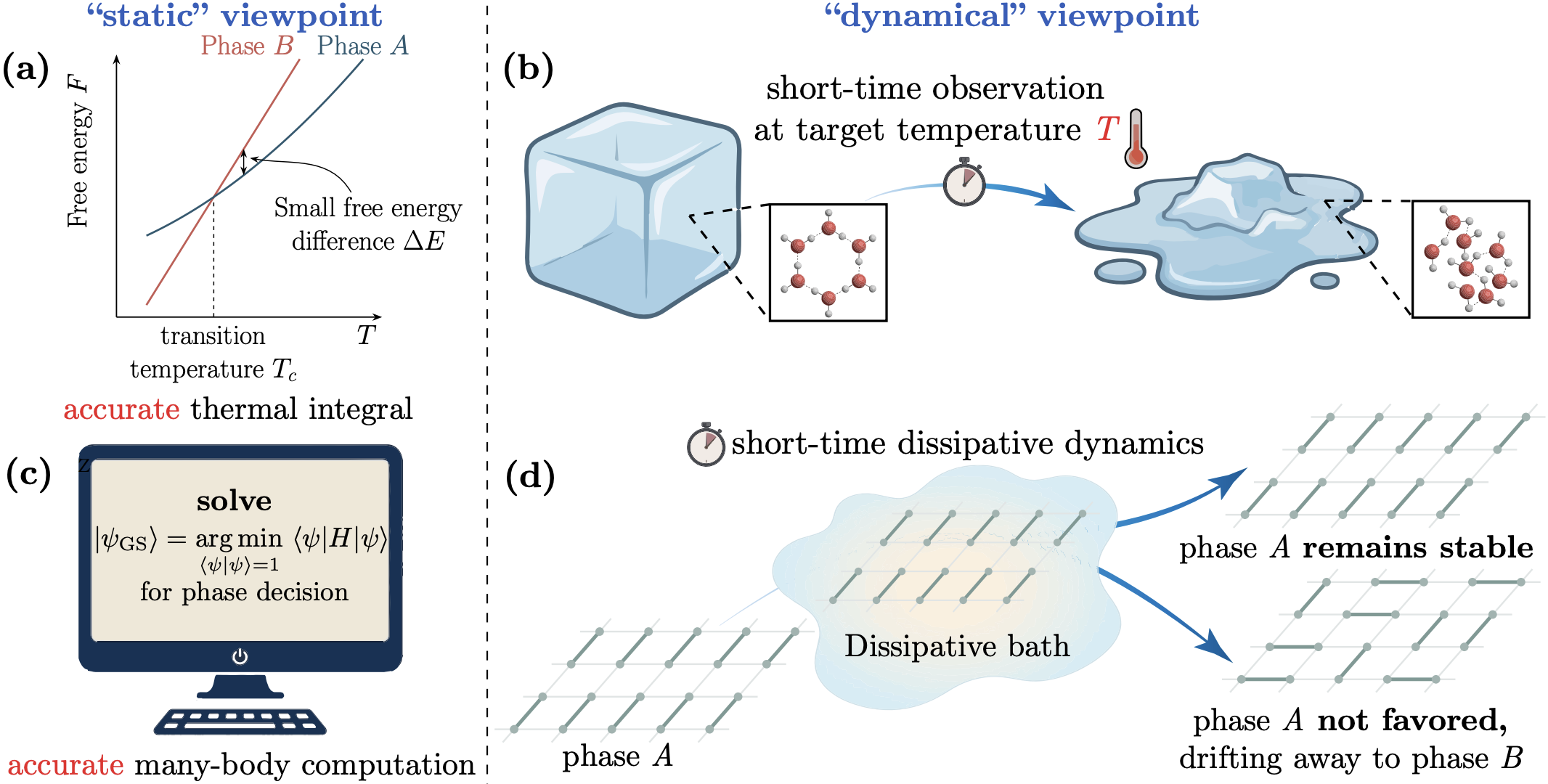
Many proposed dissipative algorithms are designed for the fault-tolerant regime and remain beyond the reach of near-term quantum devices. Here, we focus on a more realistic setting and ask what can be achieved using quasi-local, short-time dissipative cooling protocols[2,3]. We find that, although such protocols do not prepare the exact ground state, they can rapidly access a low-energy manifold that retains rich physical information, including signatures of quantum phases. Notably, this includes Berezinskii-Kosterlitz-Thouless (BKT) transitions with exponentially small spectral gaps, as well as topological phase transitions in Chern insulators.
References
- [2] Z. Ding, C.-F. Chen and L. Lin, Phys. Rev. Research 6, 033147 (2024)
- [3] Y. Zhan, et al., Phys. Rev. X 16, 011004